Showing posts with label Polycrete. Show all posts

Wednesday, November 19, 2014

Theft of a Sale (Bryant Wheeler)

I was drug up in the construction industry as my father was before me. I was tarring foundation walls as soon as a brush would fit in my hands. It was a time when your word carried more merit than a signature on a paper. When a contractor not only built a building he also built a reputation. A reputation of self-worth, value, character and honoring one’s word. This stood in life no matter if it were private or business affairs.
Polycrete USA still recognizes and lives by these values. Sure we get things in writing – but the word of a person or business still holds value to this day. We see and hear all too often in this ICF industry where an installer or distributor is working on a deal but the manufacture takes it in house because they are afraid to lose a truck load of forms. Maybe they think the person working the sale can't close it. Or maybe perhaps they just jumped the gun. Either way, if it’s your lead, it should be your sale.
When the manufacture takes your customer in house for whatever reason without your consent this is theft of a sale.
If you, the installer, contractor or manufactures rep, feel you can't close the deal on a PolycreteUSA lead you should call for help. I for one love to help close deals. But it’s still your sale. We are not going to sell direct without paying the rep, and we are not going to send another crew to the site to do the erection. That is your job.
We know how hard you work to make a sale -- so much goes into it. First you must get the lead from somewhere. If it’s by word of mouth this is because you have built a reputation with someone and that’s a beautiful thing.
If the contact comes from a lead source this costs hard earned money out of your pocket. Either way you put countless hours into working this sale. From convincing the customer that is the best way to build, to working with their architect and making suggestions to their engineer.
It could be a developer you have to pitch. Maybe you point out a tax incentive, insurance breaks, make site visits and general schmoozing -- most of the time it is all of the above including your reputation for doing good honest work.
Coming from the construction industry, later joining the Marine Corps then back into construction, acting honorably has been imbedded into me and this is why we do what we do. I would like to challenge ALL the manufacturers and installers to try to live by these values. To assert great character and build this industry on honesty and self-respect.
This industry has seen the bottom. Let’s all of us grab our boot straps now and pick it back up. Work together for the greater good. We need to do this with old values and new technologies. If we treat our partners, supply chains, and distribution channels ethically and honorably we can show America that ICF technology’s time has come.

Bryant Wheeler, Executive VP
PolycreteUSA
Richmond, Virginia

Monday, November 3, 2014

Sometimes the ICF industry is its own worst enemy.


A picture in a recent issue of Concrete Homes and Low Rise Construction is just one of many examples I see happening.

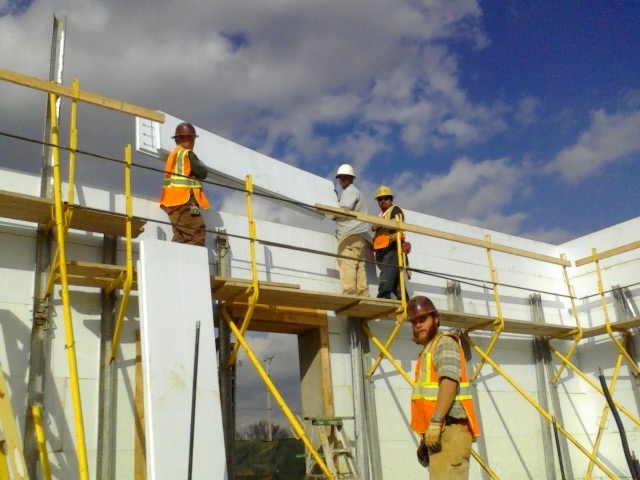
Forty-three feet off the ground, there are no hard hats, no guardrails on the scaffold, no safety line, no backup man on the pump nozzle, no internal vibration, walk board cantilevered dangerously off to one side, and another walk board appears to be a TJI! This sets a bad example for ICF in general – makes installers look irresponsible to GCs. Worse yet, the general public may think this is perfectly fine.

Recently, an ICF installer proudly posted a well-produced video of his pour on YouTube. Again, no hard hats, no safety rails and no internal vibration. There’s a guy on the ground, directly beneath the nozzle man banging on the wall with a 2x4! One commenter asked if that’s the manufacturer’s recommended way to vibrate the wall. Another mentioned that it did not look OSHA compliant. The installer replied that the job was “out in the middle of nowhere,” so OSHA was not likely to drop by.

Irresponsible installers and suppliers are damaging our industry. There is a debacle underway on a higher-education project  right now. An ICF manufacturer persuaded a large well-known GC that the ICF spec as written was too tight and if they allowed in the lower grade block and a cheaper installer, they’d save some money.

The result is a big mess -- walls out of plumb and straightness. The GC reportedly tried to find another installer to take over the job, but no reputable installer wants to go near it. I don’t know what the job’s status is now. The GC, who we’ve been working on for years, told us their ICF experiment is likely over. Fool me once, shame on you. Fool me twice, shame on me.

This is a pattern we’ve seen repeatedly on Military bases. ICF manufacturers chase each other’s prices down to absurd levels. The manufacturer agrees to sell material direct to the GC at a cut-rate price and pressures the installer to bid a low, labor only price. What does this accomplish other than the sale of a few truckloads of material at little or no profit? Well, for one thing, it creates an impression in the commercial/government market that pricing SHOULD be $11 or $12 per sqft for a multi-story building at prevailing wage, which is nonsense.

There’s more: The manufacturer takes money out of his installer’s pocket by eliminating his margin on the product and encouraging him to cut his profit on the labor portion. Top installers won’t allow themselves to be pressured by suppliers, so you end up with a less qualified installer. It also creates bitterness on the installer’s part, reduces his margin of error and moves him to cut costs and corners. When something goes wrong, he’s more likely to walk away because he can get upside down very quickly.

Since ICF construction is relatively new to the commercial market, most GCs are still not knowledgeable about its vagaries.  Estimators are encouraged to buyout as aggressively as possible. When a less than ethical salesperson starts pushing a cut-rate price, the estimator lets himself get talked into believing there will be no difference in the final product -- even though common sense tells him otherwise. When you’ve got four subs bidding $15 a foot and one at $11, it’s probably not the $15 guys that are out in left field.

Far too often, these stories have ugly endings and when the finger pointing starts, it’s ICF construction in general that gets the blame. That big influential GC that we want on our side is left with a bad taste in its mouth. In the corporate world, new things that go bad rarely get a second chance.

When we raise these issues on various ICF forums, we are told to quit being negative and just say happy things – be supportive of our industry.

Well we’re happy to say that there are good products out here that are good for building houses and there are good products out here that work best in commercial. There are great installers doing terrific work all across the country. But every ICF is not the solution to every job and picking the installer’s pocket will not motivate him to do his best work.

I challenge the rest of the industry to increase installer training and standards, stop referring business to any sub willing to install your product and end this cannibalization so our industry can achieve the respect and credibility it deserves.

(This article was originally printed in Concrete Homes and Low Rise Construction Magazine September 2014)

Thursday, January 2, 2014

ICF Industry Consolidation

ARXX Building Products filed bankruptcy at the end of December . In the beginning of the month, Reward Wall announced that it’s selling its assets to Airlite/Fox Blocks.  Here’s my take on the current consolidation in the insulated concrete forms market.


Nearly all the ICF products generally available in the marketplace are considered “residential grade” and are essentially identical. Two panels of Type II EPS joined by plastic cross ties. They’re all about the same size and shape and all have about the same baseline performance.

There are only three outliers of any substance: Polycrete, ARXX Steel and Nudura (I’m not sure if the ARXX Steel line is still available). Some might consider knock-down blocks in a separate category, but their steep installation labor costs ensure they will remain a niche product.

Since nearly all residential grade ICF products are alike, since they compete primarily on price, since there is a concerted price war in the market, we can expect to see more companies like ARXX and Reward Wall being absorbed and disappearing.  There are too many similar brands chasing too few jobs. If they can’t find anything to compete on except price, consolidation is the natural result.

In this pricing environment, the best managed, structured, positioned ICF suppliers will survive. The best structured are those that control their own manufacturing. If they have a diversified product line as well, they should be better positioned to survive reduced margins. Hopefully their other product lines are profitable and can finance their price war.

Those ICF brands that have real, tangible and provable differentiators should be fine over the long term as long as management  continues to sell the unique benefits and resists the urge to leap into the price war.

Recently we lost a job to Nudura. It was a small job. They came in at half of our price. When the contractor told us Nudura’s quote, we said, “Sorry, we don’t sell our product that cheap,” and walked away. We know our costs, we don’t sell below cost, and we’re always happy to let our competitors lose money.

It’s difficult to tell where this consolidation will end. Airlite/Fox seems to be the big dog in the fight. They have their own manufacturing, a diversified product line and the financial heft to hang in for a longer time.

This type of highly aggressive pricing can be a minefield for the entire industry. One danger is that small manufacturers and those that outsource will try to hang on by cutting costs and quality. More high profile failures by inadequate products will damage the entire industry.

A second hazard to the industry’s reputation is the habit of selling material directly to GC/Owner. This may aid the supplier’s margin, but it cuts out the installer’s profits. ICF suppliers that squeeze installers are slitting their own throats. It’s a habit that reduces the installer’s margin of error and increases the likelihood of him losing money or walking off the job. It happens and we all know it.

One more hazard is overselling product or aggressively selling into an inappropriate market, which causes troubled installations. This results in disappointed customers and leaves a lasting bad taste in the mouths of construction/A&E professionals.  

If you have a residential grade product, stick to houses. This is a sword that cuts  both ways. Polycrete products work best in a commercial environment. Many of our installers do residential work as well, and we always encourage them to use the right product for the job. When presented with an opportunity that’s not appropriate for Polycrete, we don’t hesitate to hand it off.

In my opinion, those ICF suppliers that cannot survive long term should read the handwriting on the wall and cut the best deal they can with a firm that has its own manufacturing capacity sooner rather than later. Alliances, equity deals and earn-outs are easy to structure if everyone’s serious and all can be winners. That will get the consolidation over with and our industry can go on to make some money.

Sunday, November 24, 2013

Fix It Anyway

“If it ain’t broke, don’t fix it.” A time tested proverb, right?

Well, I came across an ad for GMC trucks the other day that talked about using a rolled steel process rather than the normal stamped steel for making the truck bed. Even though there’s nothing wrong with the stamped steel process, they found they could make truckbeds lighter, stronger and more durable using a different process. GMC calls this mind-set “an adamant desire to fix the unbroken.”

R-Stak inserts are a full eight feet long
That’s what we're doing with our R-StakTM inserts. Gluing and screwing EPS boards to the outside of an ICF wall is a perfectly fine way to add more insulation. It’s been done that way for a long time. Except it leaves the studs buried 2.5” from the outside surface so you need longer screws and a better aim with the screwgun to fasten your exterior finish.

Other ICF companies came up with the idea of moving the extra insulation to the inside of the cavity. They make 8 inch wide EPS inserts that slip between the cross ties inside the ICF where the concrete goes. That usually works ok, too. And then you don’t need such long screws to reach the studs because they’re right there near the surface.

We took that good idea and made it great with R-StakTM inserts.  Full 2 foot x 8 foot panels that drop into the concrete cavity in one motion and use only fraction of the labor. We make two standard thicknesses, but customization is a piece of cake so you can have just about whatever thickness you need.

Expander clip holds R-Stak firmly in place
Our flexible manufacturing lets us make the cavity up to 24” wide so you can easily add ridiculous amounts of insulation and have as thick a concrete wall as you want. Ingenious expander clips snap into place and secure the R-StakTM insert without need for glue or screws.

America wants energy efficient structures that stand up to Mother Nature. That doesn't have to be hard, and PolycreteUSA just keeps making it easier. 

Adding extra insulation to your ICF wall wasn't a broken process, but we fixed the hell out of it anyway. Call us today to learn how we can simplify your project. 

Thursday, July 25, 2013

PolycreteUSA’s new website makes it easier for architects, contractors and building owners to learn about a better way to build...

PolycreteUSA’s mission is to make it easy to design, build and own energy efficient structures that stand up to Mother Nature. We took another big step in that direction recently with the launch of a new website, PolycreteUSA.com.

We want to get our story across more clearly. Who we are, what we do and how we do it. We think the new format accomplishes that. Our technology has been used in Canada, Europe, Asia and even here in the US since 1988, but a lot of people here still think of it as new and mysterious. We want everyone in the construction community to see how cool it is and to realize that this technology really will make their project easier to complete.

Polycrete’s technology is a system for constructing commercial buildings with highly insulated concrete walls. Conventionally formed concrete walls involve a labor-intensive process of constructing a wood or metal formwork structure, filling it with concrete, then dis-assembling all the formwork after the concrete hardens. 

The Polycrete formwork is set up in a fraction of the time and does not have to be dis-assembled. It’s made from expanded polystyrene panels that contain a steel reinforcing structure which makes it strong enough to contain the concrete. Since the formwork becomes the insulation for the building, it also eliminates the insulating step in the construction process.

The Polycrete system eliminates several other steps, too. Four or more. Normally you would have to build a wood or steel stud wall inside the masonry wall to hold your insulation and sheetrock. That all goes away with this system because you can attach sheetrock directly to the Polycrete wall by means of its built-in steel fastening strips.

The new website includes useful information for architects, contractors and building owners.

Architects will be pleased to see CAD files that can be downloaded to make their design work easier and detailed information on how doors, windows, floors and roofs are incorporated.

Contractors will find complete information on assembling  Polycrete walls and how it works with electrical, plumbing and other building systems.  

Building owners can learn about operating costs savings and even how they can benefit from Federal tax credits and deductions from using the Polycrete system.  

Building products like the Polycrete Big Block ICF system have to undergo a thorough series of tests before they are approved by the International Code Council. The ICC sets the rules that most local building codes are based on. Polycrete makes all of its ICC test results available on the website for download.

Intertek testing service ran all of our ICC tests. They’re the number one building materials testing service on earth, and I can tell you their results prove Polycrete Big Block is the strongest ICF on the market. Fastener withdrawal, shear tests, fire ratings, you name it. Some other ICFs are close to us in one or two areas, but overall, The Big Block is tops. That’s why we put all the data on the web for the world to see. This is not just a salesman making up stories, it’s the real deal.

We want to hear from construction professionals after you look over the site. It’s an evolution. We’re currently working to develop more resources for installers. In the meantime, we really want to hear what the community thinks of what we’re presenting and what you like and dislike about the site. It’s not about us, it’s about you. We’re going to continue to improve our usefulness. If there‘s other info or services you’re looking for, tell us and we’ll figure out how we can get it for you. 

The new website is at www.PolycreteUSA.com. We’re also on Facebook. There’s more pictures on the Facebook page. Contractors send them to us as their jobs progress and we just throw them up on Facebook.

Thursday, June 13, 2013

All ICFs Are Not Alike!

I haven’t had a really good rant for a long time, so here goes. Indulge me – You'll definitely learn something and you might even be entertained.

I’m angry because the ICF myths and misinformation continue. I’m tired of hearing people say all ICFs are alike. ALL ICFs ARE NOT ALIKE!

Some are utter garbage and should not be legal. Others are not legal at all. Some are OK, a few are good. Polycrete Big Block, though, is so far advanced that it can hardly even be compared to the rest. Am I biased? Of course I am! But I’m not just blowing smoke and you don’t have to take my word for it. Just stick with me for a few minutes, look at the evidence and decide for yourself.

Insulating concrete forms (ICFs) are forms for building reinforced concrete walls. They’re made out of expanded polystyrene foam. These forms stay in place after the concrete cures and serve as insulation for the building. Sheetrock attaches directly to the ICF surface on the inside and siding -- brick, stucco or whatever you like -- attaches directly to the outside surface.

It’s a great way to build highly energy efficient buildings that can stand up to Mother Nature. As long as it’s done right. This construction method has been around since the 1960’s. Very popular in Canada, it’s become more widespread in the USA over the past several years.

Let’s all agree that we have building codes for a reason. If you aren't on board with that, you can stop reading now and go back to checking the baseball scores. This article is not for you.

A series of basic tests is required for an Insulated Concrete Forming system to be approved by the International Code Council (ICC) – the governing body that most U.S. building codes rely on. The tests need to performed by an approved independent testing service. Most often, that’s Intertek, one of the largest and most well-known building materials testing laboratories on earth. 

We recently spent several days poring over technical data available on websites of all the major and some minor ICF manufacturers in North America. It’s been an eye-opening experience.

There is a “Fastener Test” in which a screw is screwed into the fastening system of an ICF test wall. The wall is a complete wall with concrete cured under controlled conditions. Using a carefully calibrated machine, the screw is then pulled out of the fastening system and the pounds of pressure required to pull out the screw is recorded. They do this several times and calculate the average.

Get this: One mainstream ICF company didn't like the results they got from Intertek, so they went out and hired a screw supplier to run their own test. Surprise! The screw supplier discovered that if you put a screw in a very specific location on their plastic stud (they call it a "Sweet Spot") you can get 500 lbs resistance. And they publicize the heck out of that. Can you imagine that happening in the field? This is the kind of misinformation and garbage people have to wade through. 

OK, back to business. The other screw test is a shear test. They test how much lateral (sideways) pressure can be applied to the screw before the system fails. The screw pulls out, the fastening web/strip breaks or the screw breaks. They also do this several times and record the average. This is important  because you want to be confident that if you screw kitchen cabinets, bookshelves or a flat screen TV to the wall, it will stay there – even when a four-year old tries to climb on it.

Let’s talk about results. On Fastener tests, the common plastic tied ICFs have screw pull ratings of about 125 – 150 lbs. Polycrete’s was an average of 311 lbs. with a maximum of 359 lbs. There was only one other ICF we could find that was in our league.

On the lateral shear test, Polycrete Big Block averaged 375 lbs. with a maximum of 420 lbs. The others we found averaged 235 lbs. That’s almost 37% weaker. We’ talking about all the mainstream ICFs. There’s only one in the same league as Polycrete on the screw pull, but on the shear test, the screws reportedly snapped off pretty easily in that one.   

These are all mainstream ICF products, and as you can visit their websites and see from the independent testing reports, they’re woefully weaker than Polycrete Big Block. 

Other tests are “flexural” and “compressive” tests where they test the actual strength and density of the polystyrene panels. The “flexural” test measures the bending strength of the EPS panel and the “compressive” test measures how hard you have to push on it in order to sqwoosh it.

Most ICFs are made from “Type II” polystyrene, and that means the manufacturer uses anywhere from 1.35 to 1.5 pounds of polystyrene per cubic foot. The greater the density, the stronger the form and the more likely it will be to hold concrete. The test results should show that.

Basic stuff, but you need to know because when you fill an ICF wall it’s a lot like dumping concrete into a throw-away coffee cup. You want to have a fighting chance of not ending up with loose concrete flowing all over the jobsite.  

Then come the fire tests. I like fire. There are two different testing protocols. This is where they measure the fire resistance of the entire wall system and also the burning characteristics of the ICF components. I say “components” because if the ICF has plastic cross ties, they have to test the EPS panels and the cross ties separately.

In the first fire test, they build a test wall -- again with the concrete cured to a specified humidity level so all ICFs can be compared like apples to apples. The wall is usually eight feet wide and eight feet tall. They wheel the wall into a furnace, heat it up and record what happens. After a while they turn a fire hose on it and see what happens. They record the results. This is serious business, and it does not come cheap.

Plastic cross ties are usually made from polypropylene and that stuff catches fire much faster than the EPS. The EPS has a flame retarder in it and the polypro doesn’t necessarily have one. For this reason, 6” thick ICF wall systems with steel cross ties usually have a four hour fire rating and the plastic-tied ICF systems are generally only good for three hours. An important consideration if having your building collapse in a fire worries you.

The second burning protocol calls for putting the ICF components into a furnace and recording how long and at what temperature the EPS panel and the injection molded plastic cross ties flame, melt or both.

They also measure the smoke generated and the “flame spread index”. For the record, the smoke generation and flame spread with nearly all ICFs is significantly less than with wood, so we can kill that myth once and for all.

Nearly all the EPS in North America comes from one of a very small handful of manufacturers of raw polystyrene “beads”. Those polystyrene bead manufacturers all use the same flame retardant chemical and supply the beads with the flame retardant included. Burning characteristics of the EPS itself don’t vary much from ICF to ICF. It’s generally the cross ties that make the difference, but you have to do the test anyway so you know the ICF is not made with some fluky pirated polystyrene.

The most interesting test of all is not yet actually required in the USA. But the fact it’s not required doesn’t mean the results aren’t very interesting to read. This is the infamous “Forming Capacity Test.”

Canadians have used ICFs much more widely than we lower forty-eighters, so they are far ahead of us in their general knowledge and experience with the technology. Canadian building code officials know that keeping the concrete inside the ICF wall is important for safety and efficiency. Canadians are also persnickety – they don’t like cheap junk. So they insist on a test that shows just how strong the ICF system is under real concrete pumping conditions.

For the Forming Capacity test, the ICF manufacturer builds an ICF wall using their published recommended construction process. Bracing is done according to the manufacturer’s published instructions. The testing scientists then install sensors in at least nine different places on the wall. These sensors measure the thickness of the wall. The testers also measure the straightness or plumbness of the wall.

Four feet of concrete is then pumped into the ICF wall and the concrete is vibrated using specific equipment and specific techniques . Fifteen minutes or so after the first lift is placed, a second four foot lift is added and that is vibrated as well in order to get proper consolidation of the concrete. Then the readings on the nine sensors are recorded, and that tells you how much the EPS foam panels have bulged from the weight of the concrete. If the ICFs break and blow out the concrete, that is noted as well.

The ICF manufacturer can choose what thickness of ICF wall he wants tested, and their designated personnel build the wall. The thicker the wall, the heavier the concrete and the greater the chance of bulging or blow out. Most ICF manufacturers choose to test a 6” wall. Polycrete tested a 10” wall.

Besides Polycrete, only one other main stream ICF supplier makes their forming capacity results available on the website. That company tested a 6” thick wall. It was not plumb when they built it, and it got further out of plumb when the filled it with concrete. They made no attempt to straighten it. I’m not making this up, it’s in the report. “Why did they build it out of plumb?” you might ask.

Experienced ICF installers know that residential grade ICF walls move when you pump in concrete, so they tilt it in towards the bracing before pumping. That’s because it’s a lot easier to push it out into plumb than to try to pull it back (think screw pull test). We’re going to assume that installers in the field remember to try to plumb it up after pumping. Oh. That wall bulged up to 3/8” also. The testers call that measurement “deformation.”

Polycrete tested a wall with 9-5/8” thick concrete – over 60% more concrete than the plastic-tied one. The Polycrete Big Block wall had zero, zero, zero  deformation. Zero. Can I say that again? ZERO.  It moved a nearly invisible 3 millimeters out of plumb over sixty-four square feet of wall surface, and that was easily fixed with a minor adjustment of the bracing. 

Don’t take my word for it, remember, I’m biased. Look at the Intertek reports. You don’t have to be Einstein to figure out which ICF is stronger.

Now you may ask, “Who cares and why?” Well, deformation is important because if the wall is all bulgy and snaky, you have to deal with it before putting up sheet rock. The common way is to bring in a team of laborers with big rasps and they shave off the high spots where the walls bulged. Undesirable things come from this: Construction delays and labor costs. You also reduce the R Value or insulation properties of the wall because the insulation is now thinner.

What if the ICF system has fastening strips (studs) exposed on the surface of a bulging wall? Flattening it will be impossible. The only way to fix that bulgy and snaky wall is by furring and shimming. More labor, more materials.

Then there are the fringe systems, and that’s where the ICF world really gets problematical. For example, there’s a heavily marketed, vertical, knocked-down system that is more like a traditional cast in place concrete form. It’s a very labor intensive and consists of a lot of parts to be assembled onsite. It’s reported to be prone to blow outs, and knowledgeable ICF people tell us they won’t touch it with a ten-foot pole.

They do a lot of marketing, but here’s the problem: That system has not undergone any ICC testing that we are able to find. No fastener tests, no compressive tests, no flexural tests and no burn tests. No forming capacity tests. No nothing.

So we called the company. No, we didn’t tell the lady who answered the phone we were from PolycreteUSA, we just said we were an interested consumer. We asked if they would share their ICC test results. Well, the phone was covered with a hand or something, there was a lot of whispering in the background, and finally the lady came back on and said no, they did not have any ICC test results to share.

She confirmed our suspicion that the vertical ICF is not a real approved, code compliant ICF system. The EPS was tested and approved for use as a perimeter wall insulation only. There are a lot of other restrictions to its use.  You can read the report for yourself. Look up ESR-1006 on the ICC-ES website. This is the report for the foam panels they claim to use in their system.

Some people may ask, “What about Pensmore?” It’s a gigantic house. It’s under construction (has been for a long time) and it’s being built out of the that system. If you look at pictures of the building under construction, you can see that the foam panels seem to be shored up with corrugated steel, and that seems to support the claims of installers who say it’s a weak system. 

The owner is building this house for himself and he chose a location that has no building regulations. The structure is not subject to inspections. He told the New York Times that building codes and inspections would “complicate” his efforts. Don’t take my word for it, read the NYTimes article.

There are other untested fringe ICF products out there as well. Most common ICFs with plastic ties are made by contract manufacturers—companies that specialize in making things out of expanded polystyrene.  The same companies that actually manufacture many ICFs also make packaging materials, take out containers and coffee cups.

Many brand name ICF companies do not actually own any manufacturing facilities. They’re really just R&D, sales and marketing companies. Instead, they pay a machine shop to make them a special mold, they deliver it to a contract EPS molding company and cut a deal for the molding company to make their ICFs to order. The plastic cross ties can be bought from China by the container load. One EPS molding company may make several different brands of ICF under different contracts.

Sometimes these EPS molders get their own ICF molds and make black-market no-name ICFs. They’re untested, have no approvals, and get sold to unsuspecting do-it-yourselfers or nefarious fly-by-night contractors. These ICFs are often weak and substandard because they’re made with lower density foam prone to bulging and blow outs. They give a bad name and black eye to the entire industry. Cheap contractors want us to try to compete with them price-wise. We won’t do it.

Polycrete Big Block is manufactured on Polycrete equipment in Polycrete factories, to Polycrete standards. We do our own steel fabrication and mold our own EPS. We use no contract molders. Our EPS panels have a steel cross tie system and welded steel wire mesh inside the polystyrene panel for strength. No other ICF has this feature. It prevents bulging and blow outs. That sets Big Block™ very far apart from the crowd.

Big Block™ stands up to 1,600 lbs per square foot of lateral pressure. We invented a machine to measure that strength. We actually got it up to 2,000 lbs and the machine broke before the form did. But we only claim 1,600 lbs. It’s enough. We also measured a bunch of conventional ICFs, and none of them passed 800 lbs. It’s that forming capacity thing.

Big Block™ is also the largest ICF anywhere. Standard size is 2’ x 8’. Install sixteen square feet of wall in one motion and that’s faster than any other ICF on the planet. Yes, there is another 8’ long product, but it’s only 18” tall and it has big clunky plastic cross ties that impede the flow of concrete and can break if they get hit by a rock while pumping concrete. Blow out city.

Cheap materials don’t make a lower cost building if they result in added labor costs, more headaches and construction delays. Who wants angry and frustrated customers? In the end, you get to decide. Are straight, flat walls important to you? Is finishing on time and on budget important? Is jobsite safety and disaster performance important?

Polycrete’s mission is to make it easy to build energy efficient structures that stand up to Mother Nature.  Whether it’s by partnering with other technologies to reduce steps in the construction process or bringing in consultants to help you take advantage of energy efficient tax breaks. We constantly look for ways to make your life easier and building experience better.

Two words about installers: Due diligence. A bad installer can screw up the best ICF in the world. Believe me, I’ve seen it. Pick them carefully. PolycreteUSA seeks out commercial concrete contractors and trains them to install our ICFs. They understand the challenges of commercial construction and already know how to work with concrete. Many ICF installers are wood framing crews trying to move up the food chain. Some work out fine, a lot don’t. Once again: Due diligence.

PolycreteUSA is not interested in one-offs. We want to be your ICF supplier for life. We’re on the team. We are always going to deliver a premium product, we don't snow you with marketing hype and we always have your back.

I hope you found my rant worthwhile. Thanks for your time.


Thursday, January 10, 2013

Top Concrete Contractors Join TeamPolycrete

Always on the prowl for new installers who can advance our mission to make it easy to design, build and own energy efficient buildings that stand up to Mother Nature, we've recently added two big dogs and one rising star.

Century Concrete, headquartered in Virginia Beach, serves the Richmond area from its Ashland location and Northern VA from Manassas. Led by Preston White, Century is one of Virginia’s most highly respected concrete contractors and has now added Polycrete ICF installation to its service offering.

The Burke Family has a long history of concrete construction in the Maryland and DC area. Brian Burke of Burke Concrete Construction has been an advocate of ICF construction for many years and developed a green construction division in 2009 to focus on ICF installation.

Jason Carey, owner of Hamptons ICF in Sag Harbor, New York is a native New Zealander. He’s built both residential and commercial in New Zealand, France, Switzerland and the US since 1990. Jason is also a Cuisine Professional who designs and builds world class restaurants and kitchens. These days, he’s a leading ICF installation contractor in Eastern Long Island and works in NYC as well.

Access PolycreteUSA’s Complete installer list.   


1-800-570-4313


Wednesday, January 9, 2013

K-12 Building That Generates Cash? Go Figure...

The Nation’s first net zero energy school was the subject of an article in Forbes recently because it just got its first full annual electric bill… errr, check. Yep, that’s right, after a full year in service, Richardsville Elementary School was paid $37,227 for the energy it delivered to the local electric utility.

If you were asked to guess where Richardsville Elementary School  is located, you might suggest California, Massachusetts, or Vermont -- where Prius ownership is highest and the politics bluest. Well, the answer’s nope, nope and nope. Richardsville’s in that red state of Kentucky.

Yes, Kentucky. Where the grass may be blue but the politics are red. Where coal is king, electric costs are the fourth lowest in the nation, and energy efficiency innovations yield taxpayers $3.3 Million in annual avoided costs.

You might ask what it means to be “Net Zero Energy”. It means that the building generates all the energy it needs (or more) to operate using various passive and active strategies like solar, wind, geothermal, etc. Public utilities are usually required to buy any excess energy generated from alternative energy producers hooked up to their grid and hence the check instead of a bill.

Typical annual energy costs for K-12 schools in the US are $1.25 per square foot. At 77,466 square feet, Richardsville earned almost 48¢ per square foot. In a state like Virginia, where average electric costs are 12.5¢/Kwh, that would translate to almost 75¢ per square foot or $58,100 per year in earnings and $155,000 in annual avoided costs. Assuming an interest rate of 3% and no increases in energy costs, that works out to more than $3 million saved over the expected life of the building.

You’re probably thinking that it costs a fortune to build such an efficient building and the up-front investment won’t stand up to economic analysis. You’d be wrong, though.

According to the National Clearinghouse for Educational Facilities, a program of the National Institute for Building Sciences, average Elementary School  construction cost in the US in 2010 was  $190 per square foot, and Richardsville came in at $156.

Part of the reason for the affordable construction costs is that it’s built with insulated concrete form technology. ICFs like Polycrete® Big Block™ are a very cost effective strategy for achieving high insulation value in walls and that allows downsizing of HVAC systems. ICF technology also adds of lot of other cost-saving attributes. A key to making the overall economic model of a net zero energy building work is controlling the costs of construction.

How does something like this happen? Well certainly not overnight. It took careful design and planning over a decade. Now, nearly all twenty-one schools in Kentucky's Warren County meet Energy Star certification. That accomplishment has resulted in more than $5 million in avoided energy costs to date. Real dollars that taxpayers did not have to shell out.

Richardsville’s Net Zero accomplishment is a result of its innovative building design. Although it’s  a typical school with classrooms, gym, cafeteria and such, many features are unique. Everything from the heating and cooling system to the lights work with sensors that automatically determine appropriate light and temperature levels and then make adjustments.

Most schools in the US operate at 73kBtus per square foot. The average Warren County Kentucky school uses 40.  In 2007, Warren County built Plano Elementary School to use 28. As it continued to work with its crack team of architects and engineers, it leveraged the lessons learned from Plano to design Richardsville to operate at 18 kBtus per sqft.  That’s less than 25% of the average school’s energy usage.

In 2008, Kentucky Governor Steve Beshear launched “Intelligent Energy Choices for Kentucky’s Future, Kentucky’s Seven Point Strategy for Energy Independence.” Despite that Kentucky is the nation’s 3rd largest coal producer, the commonwealth's governing team introduced this far-sighted and ambitious program that's paying off in real dollars. 

It’s an oft repeated proverb that the cheapest energy is the energy you don’t use, but opponents of net zero insist it’s just a theory that won’t work in the real world. The Net Zero model that Richardsville Elementary’s design team pioneered has blown up that argument once and for all.

Imagine how net zero schools and government buildings will reduce the pressures on state and local budgets. Elimination of energy costs will free up funds for more teachers or other educational resources. Now that Richardsville’s proven the net zero model, we can feel comfortable repeating it for all new school construction. Our students and taxpayers deserve it.

For information on building your net zero design team, please call or email Bruce Anderson, PolycreteUSA 1-800-570-4313 Bruce@PolycreteUSA.com


Tuesday, December 11, 2012

Post-Sandy Flood Maps Come With Big Changes


FEMA is releasing new post-Sandy flood maps.

Technically known as Advisory Base Flood Elevations (ABFE), these are updated estimates of the water levels associated with a flood event that has a 1% chance of being equaled or exceeded in a given year (the notorious 100 year flood). These maps are being released to the municipalities and the municipalities will likely accept them and incorporate them into their code.

Closing the Breach at Mantoloking, NJ
USACE Photo
(Click to enlarge)
They’re going to show higher elevations than those on the current maps. They’re also going to show coastal flood areas extending further inland than those on the current maps. They’re including re-drawn AdvisoryZones, areas of structurally damaging wave action and Hurricane Sandy high water marks.

FEMA began releasing the ABFEs for New Jersey’s inland counties last week. Those for the shore counties are coming out this week, and New York City and Westchester’s new ABFEs will be released next week (12/17/2012). FEMA has not yet decided if Long Island’s maps need to be updated, but the devastation we saw in Amityville alone would tend to imply they do.

A complete re-study of the New York and New Jersey coastline was already in process when Sandy hit. The new maps were scheduled to be released in Mid-2013, but recent events compelled FEMA to put out these advisories in advance of the official release so that intelligent re-building can get underway.

Between the new ABFE flood maps and the ramifications of the Biggert-Waters bill, it’s clear that homeowners in the affected areas need to take some action or they stand to find flood insurance premiums going through the roof.

Biggert-Waters is the law that reauthorized the National Flood Insurance Program. It was signed in July 2012 and makes a lot of changes. For instance, subsidies will be phased out for many building types other than primary residences. Even primary residences that have incurred excessive losses in the past will lose the subsidy.

Under Biggert-Waters, rates are also going up if there’s a change of ownership, a lapse in coverage, substantial improvements or -get this- “a mapped change in flood risk.”

Houses on left were properly elevated and substantially
undamaged. Houses on the right were not so lucky.
Building owners should evaluate actions they can take to reduce that risk. Not just because the new rates will reflect the full flood risk of the insured properties, but in order to avoid the heartbreak of being wiped out by another flood.

FEMA recommends strategies to reduce future losses. One of the best is to raise your building above the minimum required elevation. Generally, the higher the building is over the minimum required elevation, the lower the premiums and the lower your flood risk. 
That just makes sense. And it’s not as complicated as it seems.  

If you’re covered under the National Flood Insurance Program and have damage valued at 50% or more of the pre-market value of the house, you may be able to get $30,000 towards the cost of elevating the house. It’s called an ICCClaim. If your damage is less than 50%, there are other scenarios and programs that may be able to help you cover the cost.

The actual process of elevating the structure is usually pretty straightforward. Your contractor will pierce the existing foundation and slip steel girders under the floor joists. Hydraulic jacks are then used to raise the building up off the foundation.

Concrete block foundation washed
away  by Sandy's storm surge
 
If your existing foundation is damaged or made from concrete block, your contractor should remove it and replaced with a cast in place concrete foundation. Polycrete ICFs are a very fast, economical way to retrofit a cast in place foundation on an existing structure.

Different categories of flood advisory zones call for different types of foundations, so bear in mind that you’ll need to check with a structural engineer and your local building officials to determine what sort of new foundation is required for your structure.

We have a list of qualified architects and structural engineers who can advise you on the proper foundation for your building, and we also have a list of recommended, licensed contractors who can handle the job. 

Depending on your particular circumstances, it's very likely you can have your structure elevated and new foundation formed in the next several weeks. In many cases, Polycrete foundations can be poured right through the winter. 

Please call or email us to get started, and don't forget, for every square foot of Polycrete ICFs sold in the region through the end of 2013, we're contributing to New York and New Jersey's rebuilding funds.  


     Richmond, VA  •  Bridgewater, NJ   •  Amityville, NY  

800-570-4313

PolycreteUSA.com


Thursday, March 1, 2012

PolycreteUSA Assists Army Corps of Engineers Set New Construction Standards


PolycreteUSA Executive V. P. Bryant Wheeler announced today that the U.S. Army Corps of Engineers has signaled broad approval of insulated concrete forms (ICF) construction by issuing a service‐wide Unified Facilities Guide Specification. This approves the system for general use on Army construction projects and sets product quality and installation standards. “We’ve been working with the Army and Navy for several years now to get this accomplished,” Wheeler said, “and we’re very happy to have reached this milestone.”

ICFs are hollow blocks made from expanded polystyrene (EPS) that are stacked up to form a wall. Reinforcing steel is placed into the hollow and it’s filled with concrete. The result is a sandwich-like wall where the EPS is the bread and the concrete is the meat. EPS serves as insulation and the concrete provides strength. ICF buildings are very strong, very energy efficient and very quiet.

Wheeler said that he began building houses with ICFs nearly thirty years ago because of the high insulation properties, but ICF technology has just recently advanced to the level demanded by military and large commercial construction development. “I became involved with Polycrete® about four years ago when the Big Block™ product was introduced. I always thought ICF would be a great way for the military to build, but the product quality was not up to snuff. Because of its size, strength and engineering design, Big Block™ solves that problem.”

Wheeler had served in the Marine Corps, so he contacted his former commanding officer Major General Michael Sullivan, who arranged a meeting with the Naval Engineering Facilities Command (NAVFAC). “I brought Serge Meilleur, the President of the Canadian company who developed the product down to meet with NAVFAC. We met with top NAVFAC engineers in Norfolk, and they said that they’d never seen an ICF as big or strong as Big Block™. They thought it would have a real impact on military construction and troop protection. That began a four year journey.”

All branches of the service as well as the Veterans Administration, Department of Labor and other agencies have constructed ICF buildings. But it has always been on an ad hoc, case by case basis. There have never been uniform product quality and installation standards. Those standards, called Unified Facilities Guide Specifications (UFGS) are used by all branches of the military and other government entities. Until ICF had its own UFGS specification, there would always be a question of main-stream acceptance.

“After about a year spent trying to get the Corps of Engineers and NAVFAC to design some ICF buildings,” Wheeler said, “we were told we needed to get the criteria room people to write a UFGS spec. We established some solid contacts in the Civil Works Structural Engineering Division of the Corps of Engineers, and they helped start the process.”

The U.S. Army Corps of Engineers (USACE) regularly solicits input from the construction community, so PolycreteUSA submitted a draft UFGS specification in 2009. By 2011, USACE returned its version to PolycreteUSA and at least one other national ICF manufacturer for comments.

“Polycrete® Big Block™ is significantly different from traditional ICFs,” says PolycreteUSA President, Bruce Anderson, “so we had to make sure the spec the Corps wrote permitted features like our horizontal fastening system. We also encouraged them to include minimum strength requirements since lower quality ICFs tend to break or become deformed when concrete is poured into them. In Government contracting, where jobs go to the lowest bidder, there’s a tendency to gravitate to the lowest priced materials and that can translate to low quality. We don’t mind competing, but we want to compete with other top quality products.”

“The form strength component in this spec is where Polycrete® stands apart,” said Wheeler. The rule requires installers to construct their formwork to comply with the American Concrete Institute’s standards. “If the strength of the ICF alone isn’t sufficient – and many of them aren’t -- the installers will have to shore them up. That means higher material and labor costs. Since Big Block™ withstands 1,600 lbs per sqft, we won’t ever have to worry about that. Polycrete® buildings go up very quickly and safely with lower labor costs.”

The last six months have been instrumental for the industry and Polycrete® in particular. In September 2011, the American Society of Heating, Refrigeration and Air Conditioning Engineers (ASHRAE) cited the benefits of ICFs for constructing energy efficient K-12 schools. At the same time, the federal government began specifying Polycrete® products for secure facilities like data centers, and this new UFGS spec for ICF construction heralds an expansion of the market for Polycrete® Big Block™.