PolycreteUSA Executive V. P.
Bryant Wheeler announced today that the U.S. Army Corps of Engineers has signaled
broad approval of insulated concrete forms (ICF) construction by issuing a
service‐wide Unified
Facilities Guide Specification.
This approves the system for general use on Army construction projects and sets product quality and installation standards.
“We’ve been working with the Army and Navy for several years now to get this
accomplished,” Wheeler said, “and we’re very happy to have reached this
milestone.”
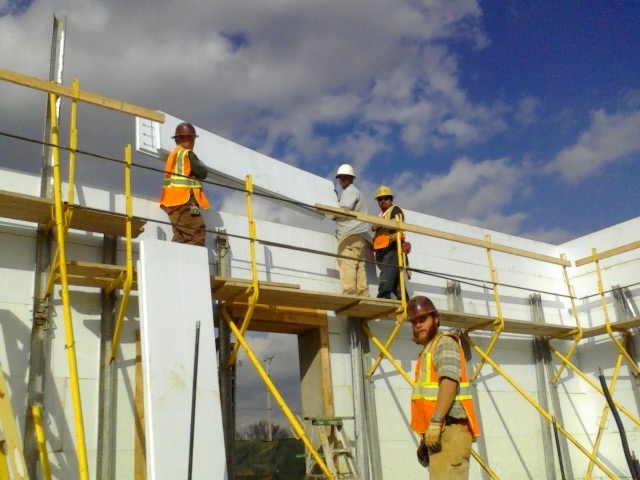
ICFs are hollow blocks made from
expanded polystyrene (EPS) that are stacked up to form a wall. Reinforcing
steel is placed into the hollow and it’s filled with concrete. The result is a
sandwich-like wall where the EPS is the bread and the concrete is the meat. EPS
serves as insulation and the concrete provides strength. ICF buildings are very
strong, very energy efficient and very quiet.
Wheeler said
that he began building houses with ICFs nearly thirty years ago because of the
high insulation properties, but ICF technology has just recently advanced to
the level demanded by military and large commercial construction development.
“I became involved with Polycrete® about four years ago when the
Big Block™ product was introduced. I always thought ICF would be a great way
for the military to build, but the product quality was not up to snuff. Because
of its size, strength and engineering design, Big Block™ solves that problem.”
Wheeler had
served in the Marine Corps, so he contacted his former commanding officer Major
General Michael Sullivan, who arranged a meeting with the Naval Engineering
Facilities Command (NAVFAC). “I brought Serge Meilleur, the President of the
Canadian company who developed the product down to meet with NAVFAC. We met with
top NAVFAC engineers in Norfolk, and they said that they’d never seen an ICF as
big or strong as Big Block™. They thought it would have a real impact on
military construction and troop protection. That began a four year journey.”
All branches
of the service as well as the Veterans Administration, Department of Labor and
other agencies have constructed ICF buildings. But it has always been on an ad
hoc, case by case basis. There have never been uniform product quality and
installation standards. Those standards, called Unified Facilities Guide
Specifications (UFGS) are used by all branches of the military and other
government entities. Until ICF had its own UFGS specification, there would
always be a question of main-stream acceptance.
“After about a year spent trying
to get the Corps of Engineers and NAVFAC to design some ICF buildings,” Wheeler
said, “we were told we needed to get the criteria room people to write a UFGS
spec. We established some solid contacts in the Civil Works Structural
Engineering Division of the Corps of Engineers, and they helped start the
process.”
The U.S.
Army Corps of Engineers (USACE) regularly solicits input from the construction
community, so PolycreteUSA submitted a draft UFGS specification in 2009. By
2011, USACE returned its version to PolycreteUSA and at least one other
national ICF manufacturer for comments.
“Polycrete®
Big Block™ is significantly different from traditional ICFs,” says
PolycreteUSA President, Bruce Anderson, “so we had to make sure the spec the
Corps wrote permitted features like our horizontal fastening system. We also
encouraged them to include minimum strength requirements since lower quality
ICFs tend to break or become deformed when concrete is poured into them. In
Government contracting, where jobs go to the lowest bidder, there’s a tendency
to gravitate to the lowest priced materials and that can translate to low
quality. We don’t mind competing, but we want to compete with other top quality
products.”
“The form
strength component in this spec is where Polycrete® stands apart,” said
Wheeler. The rule requires installers to construct their formwork to comply
with the American Concrete Institute’s standards. “If the strength of
the ICF alone isn’t sufficient – and many of them aren’t -- the installers will
have to shore them up. That means higher material and labor costs. Since Big
Block™ withstands 1,600 lbs per sqft, we won’t ever have to worry about that.
Polycrete® buildings go up very quickly and safely with lower labor costs.”
The last six
months have been instrumental for the industry and Polycrete® in particular. In
September 2011, the American Society of Heating, Refrigeration and Air
Conditioning Engineers (ASHRAE) cited the benefits of ICFs for
constructing energy efficient K-12 schools. At the same time, the federal
government began specifying Polycrete® products for secure facilities like data
centers, and this new UFGS spec for ICF construction heralds an expansion of
the market for Polycrete® Big Block™.